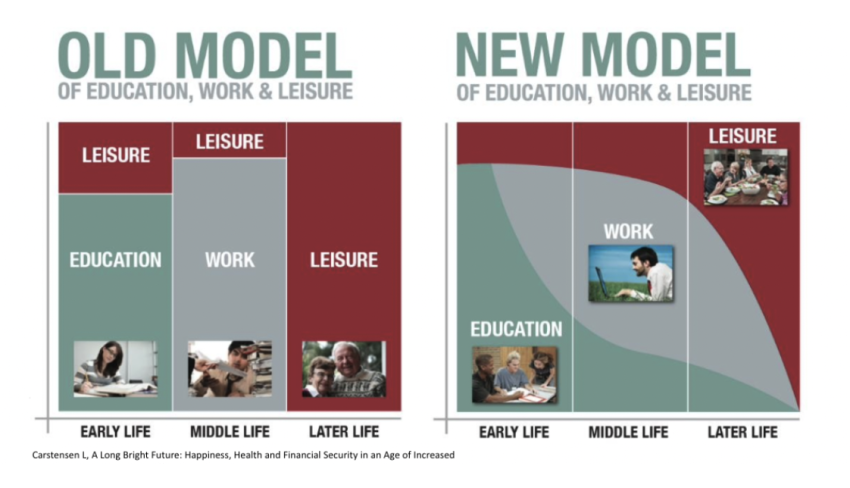
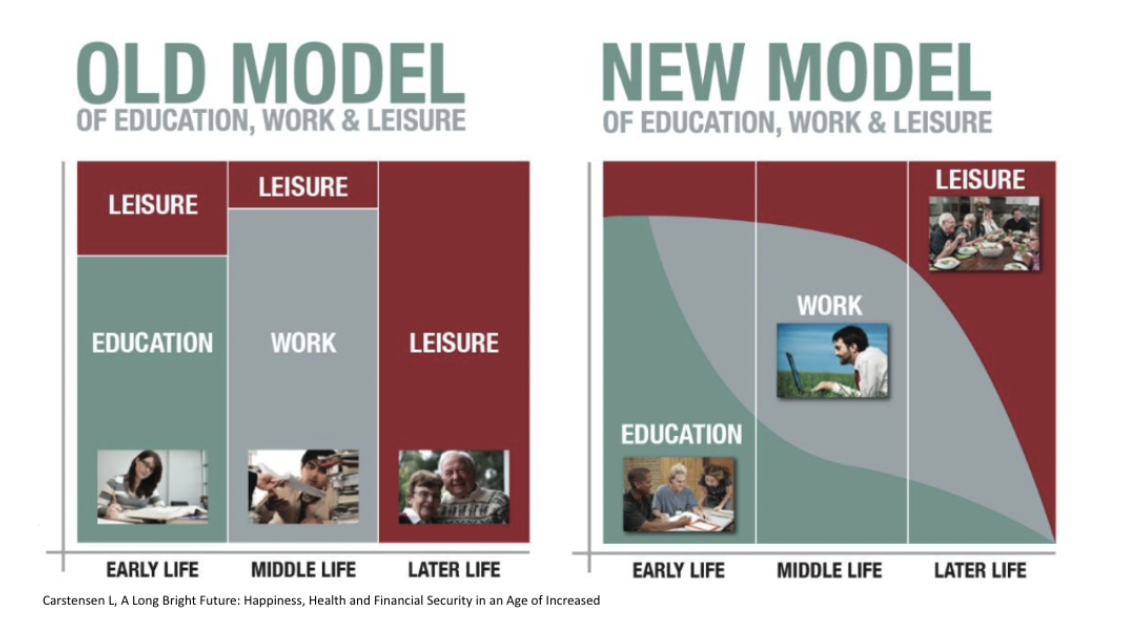
The current work-life model follows an ‘age-segregated approach’ to life, with three distinct and sequential phases of education, work, and retirement.
We typically enjoy 20-25 years of childhood and student life as young adults, followed by 30-40 years of working life as adults. Post that, we used to have 10-15 years of retirement as older adults and savings from a 40-year career were generally enough to support this period, aided by government pensions in some countries and support from children in many cultures.
With an increased lifespan, we now have an extra 20-30 years. Longer life is, of course, a cause for celebration, but we are slower to catch on to the implications of these additional years on our financial health and well-being. With the current work-life model, the extra years have extended the retirement period from 15 years to at least two or three decades.
It is not easy to sustain a 30 to 40-year retirement period with savings from a 40-year career.
We need to move away from the ‘age-segregated approach’ towards a working-life continuum or an ‘age-integrated approach,’ which suggests that life should instead be a succession of jobs, interspersed with periods of work and non-work (voluntary and involuntary) and lifelong learning.
Evolving Nature of Jobs and Reskilling and Upskilling
The future of work and the future of jobs is evolving rapidly, with the advent of technology, increasing automation, and globalization. The World Economic Forum (WEF) report, An Aging Workforce isn’t a Burden, it’s an Opportunity, states that most individuals are likely to change jobs at least twice in their working lives, voluntarily or involuntarily.
As per Bloomberg’s Countries with the Longest, and Shortest Retirements, this means at least three distinct employers for an individual before the average career ends at 65. The shift requires a mindset of lifelong learning, with periods of reskilling and upskilling. Therefore, corporations must consistently invest in employee training and engagement throughout their careers, not just for the typical onboarding.
Building Resilience and Failure Immunity
The transition between periods of work and non-work (voluntary and involuntary) means younger adults need to join the workforce with a new mindset. The individuals also need to have the mental resilience and failure immunity to manage such transitions, especially if these are involuntary in nature.
Many adults may not want to discuss financial insecurities around retirement. Still, something as simple as a short workshop on financial well-being and longevity can put more significant changes in motion. By bringing attention to the issue proactively and professionally, you can ensure that you don’t fall into the trap of ageism or age-related myths and biases.
Companies such as Walmart are helping mid-career employees manage their careers by offering “Design Your Career” workshops. Walmart Global Tech, the IT division of Walmart, partnered with Alt-Lyf to conduct webinars and workshops in 2021 and 2022 for over 500 employees in India. See details under Useful References.
Designing for a 100-Year Life (Workshops and training programs)
Bringing attention and awareness to the challenges proactively and professionally can ensure you are well-prepared for retirement. One of the best workshops for “Designing Your Life” is offered by Professors Bill Burnett and Dave Evans of Stanford University. You can start by reading their book Designing Your Work Life. They have also trained and certified coaches worldwide to promote the Designing Your Life philosophy to tackle the difficult transition points in life.
In Singapore, two courses are offered by NUS-SCALE (the Continuing Education arm of the National University of Singapore). Recognizing the importance of such a program, the Singapore government has approved the courses under its SkillsFuture program, thereby heavily subsidizing the course fees for Singapore residents. See additional details in Singapore: Designing for a 100-Year Life (NUS-SCALE).
Free online courses: Alt-Lyf offers some free online self-learning programs for individuals interested in learning independently.