Poor financial health has an adverse impact on physical and mental health. What should be done to improve the financial health and well-being of individuals?
A 100-Year Life
People are living longer and healthier. If you retire at 65 and live up to 90 or 100, do you think about financial support for those 25 to 35 years? Do you think of purpose and relevance?
Purposeful Longevity
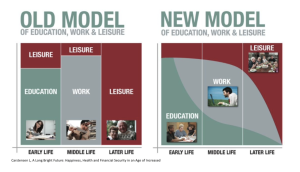
With an average lifespan of 86, and healthspan of 76, age 50 is the midpoint of your adult life. What is the 'age-integrated' work-life model for age 25 to 50? How should you plan for age 50 to 75?
Home
Designing For A 100-Year Life
Today people are living longer and healthier than ever before. Life expectancy globally has nearly doubled in the past two centuries. A child born in the West in the last decade has more than a 50 percent chance of living beyond 100, compared to just 1 percent a century ago [WHO]. A longer lifespan is a gift but can be a curse without access to adequate financial resources and financial security. People with adequate financial resources also go through phases of happiness and unhappiness, boredom and dissatisfaction, as they seek purpose and relevance.
The world currently counts a billion people over 60. By 2050, that number will double. Ensuring the financial well-being of older adults requires individuals to change their life course. It requires strong support and adaptation from various institutions such as governments, policymakers, multilateral organizations, and corporations.
Globally, systems providing financial security for the old are under increasing strain, and traditional safety nets are weakening. Senior poverty is an increasing problem in most countries, regardless of how strong they are economically. The Economist Intelligence Unit (EIU) published a report in 2020 titled “Shifting Demographics: A global study on creating inclusive environments for ageing populations,” and the results are daunting. As you can see in the Figure below, 43.8 percent of adults aged 66 and above are living below the poverty line in South Korea. That means nearly half of South Korea’s senior citizens struggle to get by. In the US and Australia, over 23 percent of the people in the corresponding age group live below the poverty line. These percentages for older adults are way higher than the national average.