
Hot Topics
- Financial security and well-being for a 100-year life
- Productive and purposeful longevity (purpose and relevance)
- Redefining work-life approach from age-segregated to age-integrated model
- Loneliness and mental health
- Impact of work on physical, mental, and cognitive health in later life
- Designing for a 100-Year Life (workshops and training programs)
The world currently counts a billion people over 60. By 2050, that number will double. Japan and Singapore are two of the fastest ageing societies in the world. The average lifespan in these countries is 84.2 and 83.2 years, respectively. The average healthy lifespan is 74.1 and 73.6, respectively. This makes 50 the midpoint of their healthy adult lives. This may seem too soon or distant, depending on where you are in your current timeline. Either way, it’s important.
It is important for people to recognize the realities of longer lives and plan accordingly for all stages of life. Four key contributors to the length and quality of life are:
- health and wellness (exercise, nutrition, and sleep)
- financial stability and financial security,
- productive and purposeful engagement, and
- supportive relationships.
There are several excellent books and podcasts that can help increase your knowledge and awareness about longevity. We have listed some of these under Resources and hope you will find them useful. We will continue to add links to new books, articles, blog posts, and podcasts and also share the information in our monthly newsletter.
Financial Security and Well-Being
Financial security is one of the critical pillars of successful ageing and has not gotten enough attention so far. It includes retirement adequacy and healthcare financing. Financial insecurity, on the other hand, is highly correlated to poor physical health and mental health.
Financial insecurity is not just a low-income bottom-of-the-pyramid problem in developing economies. It has been democratized with growing income inequalities in developed economies too and now is an issue for nearly half the American population. People across age groups are more afraid of running out of money than death.
One of the most shocking articles on this topic is The Secret Shame of Middle-Class Americans by Neal Gabler. It was published as the cover story in The Atlantic in 2016 and went viral. It cited data from the US Federal Reserve SHED report measuring the financial health of American households. It highlighted that nearly half of American adults would have trouble finding $400 to pay for an emergency, concluding that many were “financially fragile” and “living very close to the financial edge.”
Achieving financial inclusion and financial security is not an end in itself but a means to an end. It is broadly recognized as critical to reducing poverty and achieving inclusive economic growth. It also has positive effects on consumption, employment status and income, and on some aspects of physical and mental health. Greater financial inclusion is one of the key priorities of the United Nations’ Sustainable Development Goals.
Measuring Financial Well-Being of Individuals and Households
Financial well-being is not just about avoiding financial problems but also about having the ability to recover from them. Many different metrics and definitions are used for measuring this, and two of the most comprehensive ones are CFPB’s report on Financial Well-Being in America since 2017, and the US Federal Reserve’s annual SHED survey reports on the Economic Well-being of US Households since 2013. Details about the survey methodologies and the latest results are in the post titled ‘Measuring financial well-being: CFPB and Federal Reserve metrics.’
Many believe that the success of countries should be judged by the happiness of our people. The United Nations General Assembly adopted a resolution in 2013, proclaiming 20 March to be observed annually as International Day of Happiness. The World Happiness Report has some suggestions on measuring national happiness and what should be done over the next decade.
Phased Retirement
The most challenging life stage transition for people who have worked throughout their adult lives is moving from full-time work until the retirement date to not knowing what to do the next day. One possible solution is a phased retirement approach that enables older adults to transition from full-time roles until their sixties to full retirement in the late seventies.
As people age, their expectations around employability and the type of jobs also change. The phased transition via part-time or flexible jobs that allow them to work 2-3 hours a day for a few days each week is a good solution. This enables them to make some money (financial health benefit) while ensuring they get some exercise as they venture out (physical health benefit), meet other people that helps reduce loneliness (mental health benefit), and keep their brains stimulated (cognitive health benefit).
See the FAQ section ‘Phased transition and employability for older adults at ages 50, 60, 70, or 80’ for more information.
Volunteering and Learning
It is equally important to cultivate other interests and hobbies as you age. In addition, engagement in productive behaviors such as volunteering, caregiving, and learning has a beneficial impact on physical and mental health.
China announced plans in 2022 to set up the National University for the Aged to help cope with the rapidly ageing society and build a culture of lifelong learning. The extensive curriculum for those aged 60 and above will include foreign languages, computer skills, music and dance, photography, painting, sports, cooking, and other crafts and skills.
Purpose and Relevance
Some people need to work, and some want to work, while others are happy to engage in other purposeful activities such as volunteering, caregiving, learning, etc. Not all older adults need to be in paid roles in later life, but everyone needs to be productively and purposefully engaged. Everyone needs purpose and relevance. People tend to live healthier longer lives when they have a purpose and feel relevant to society.
In A Prescription for Longevity in the 21st Century, Dr. Phil Pizzo eloquently describes the role of purpose in healthy longevity. An article in The Atlantic Your Professional Decline is Coming (much) Sooner Than You Think by Arthur C Brooks, is also worth reading. He argues that professional decline might be inevitable with age, but misery is not inevitable. Ageing well is in your control.
For more information on the role of purpose and relevance in healthy longevity, refer to Purpose and Relevance.
Productive and Purposeful Longevity
Productive and purposeful longevity promotes the view that older adults can be active and purposeful contributors to their work, family, and community and engage in productive behaviors. These can include paid and unpaid volunteer work, continuing education, and housework. Studies show that productive and purposeful engagement:
- Has positive benefits on physical and mental health and increases longevity
- Provides for additional financial security; creates continued opportunities for social engagement and participation in society
- Reduces experiencing social isolation and contributes positively to life expectancy and quality of life
For more information on this, refer to Productive and Purposeful Longevity, its benefits, and academic references.’
Redefining Work-Life Approach from an ‘Age-Segregated’ to the ‘Age-Integrated’ Model
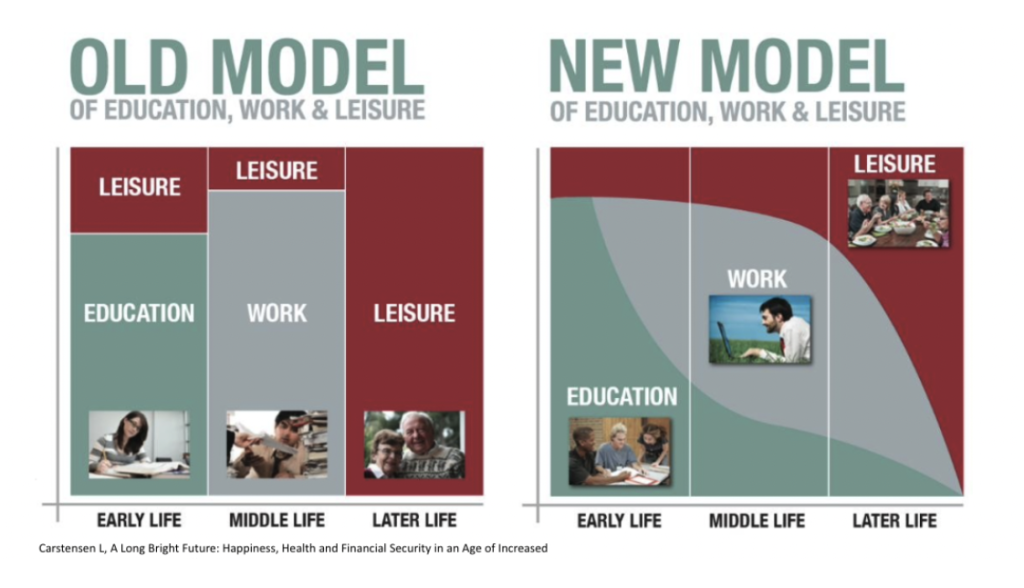
The current work-life model follows an ‘age-segregated approach’ to life, with three distinct and sequential phases of education, work, and retirement. We typically enjoy 20-25 years of childhood and student life as young adults, followed by 30-40 years of working life as adults. Post that, we had 10-15 years of retirement as older adults and savings from a 40-year career were generally enough to support this period, aided by government pensions in some countries and support from children in many cultures.
With an increased lifespan, we have added an extra 20-30 years. This is, of course, a cause for celebration, but we are slower to catch on to the implications of these additional years on our financial health and well-being. With the current work-life model, the extra years have extended the retirement period. It isn’t easy to sustain a 30 to 40-year retirement period with savings from a 40-year career.
We need to move away from the ‘age-segregated approach’ towards a working-life continuum or an ‘age-integrated approach,’ which suggests that life should instead be a succession of jobs, interspersed with periods of work and non-work (voluntary and involuntary) and lifelong learning.
Evolving Nature of Jobs and Reskilling and Upskilling
The future of work and the future of jobs is evolving rapidly, with the advent of technology, increasing automation, and globalization. The World Economic Forum (WEF) report, An Aging Workforce isn’t a Burden, it’s an Opportunity, states that most individuals are likely to change jobs at least twice in their working lives, voluntarily or involuntarily. As per Bloomberg’s Countries with the Longest, and Shortest Retirements, this means at least three distinct employers for an individual before the average career ends at 65. The shift requires a mindset of lifelong learning, with periods of reskilling and upskilling. Therefore, corporations must consistently invest in employee training and engagement throughout their careers, not just for the typical onboarding.
Building Resilience and Failure Immunity
The transition between periods of work and non-work (voluntary and involuntary) means that we need to bring younger adults into the workforce with a new mindset. That requires the cooperation of employers. The individuals also need to have the mental resilience and failure immunity to manage such transitions, especially if these are involuntary in nature.
Many older adults may not want to discuss financial insecurities around retirement. Still, something as simple as a short workshop on financial well-being and longevity can put more significant changes in motion. By bringing attention to the issue proactively and professionally, you can ensure that you don’t fall into the trap of ageism or age-related myths and biases.
Companies such as Walmart are helping mid-career employees manage their careers by offering “Design Your Career” workshops. Walmart Global Tech, the IT division of Walmart, partnered with Alt-Lyf to conduct webinars and workshops in 2021 and 2022 for over 500 employees in India.
See details under Useful References.
Designing for a 100-Year Life (Workshops and training programs)
Bringing attention and awareness to the challenges proactively and professionally can ensure you are well-prepared for retirement. One of the best workshops for “Designing Your Life” is offered by Professors Bill Burnett and Dave Evans of Stanford University. You can start by reading their book Designing Your Work Life. They have also trained and certified coaches worldwide to promote the Designing Your Life philosophy to tackle the difficult transition points in life.
In Singapore, two courses are offered by NUS-SCALE (the Continuing Education arm of the National University of Singapore). Recognizing the importance of such a program, the Singapore government has approved the courses under its SkillsFuture program, thereby heavily subsidizing the course fees for Singapore residents.
See additional details in Singapore: Designing for a 100-Year Life (NUS-SCALE).
Free online courses: Alt-Lyf offers some free online self-learning programs for individuals interested in learning independently.
Ageism Myths and Reality
Ageism and age-related biases are a big problem in most companies. So what is real, and what is a corporate myth? Chip Conley’s book Wisdom@Work: The Making of a Modern Elder has a chapter on ‘debunking ageist stereotypes.’ We have attempted to summarise the key points in a table under Useful References but have probably not done justice to the significant contributions by Richard Posthuma, Michael Campion, and others to Chip’s book. We highly recommend reading the book, or at least Chapter 9, to understand this better.
Impact of Work on Health in Later Life
The related question often arises whether working in later life is beneficial or harmful for the health of older adults. Well, that depends on the type of work.
For decades, academic and policy debates in high-income countries (HICs) emphasized the negative consequences of work on ageing (stress, physical exhaustion, worsening health) and neglected the positive effects. Consistent with this one-sided narrative, ‘protecting’ people from work through policy measures such as mandatory retirement age, fewer weekly working hours, or other measures have been considered a major societal achievement of the past century.
In agrarian and industrial societies, work was primarily physical in nature and often had a detrimental impact on health in later life. With the shift to an industrial to a knowledge/service economy, the debate needs to evolve. Recent evidence from High-Income Countries demonstrates the positive outcomes of work on health in later life. This includes physical, mental, and cognitive health benefits [MacArthur Research Network]. Rather than eliminating exposure to work in later life, these studies suggest that older adults benefit from a phased transition from full-time to part-time or flexible jobs.
There is an impressive and growing body of evidence that suggests productive and purposeful engagement is health-promoting and economically beneficial – creating continued opportunities for social engagement and participation in society and increased financial security.
Refer to this post under Useful References for more details.