
The world currently counts a billion people over 60. By 2050, that number will double. Ensuring the financial well-being of older adults requires individuals to change their life course. It requires strong support and adaptation from various institutions such as governments, policymakers, multilateral organizations, and corporations.
Globally, systems providing financial security for the old are under increasing strain, and traditional safety nets are weakening. Senior poverty is an increasing problem in most countries. The Economist Intelligence Unit published a report in 2020 titled “Shifting Demographics: A global study on creating inclusive environments for ageing populations,” and the results are daunting. It shows that 43.8 percent of adults aged 66 and above are living below the poverty line in South Korea. In the US and Australia, the corresponding number is over 23 percent. These percentages are much higher than the national poverty average. The numbers for the Nordics, France, and Germany are lower and potentially reflect the strong social support systems.
The financial well-being of older adults will be a massive challenge unless structural changes continue to be made to provide ongoing support to an increasing percentage of older adults.
In most countries, the policies mandating retirement age have not kept pace with the increased lifespan, and people continue to retire between the age of 60 to 65. It isn’t easy to support a 30 or 40-year retirement with savings from a 40-year career. This has resulted in financial insecurity among potential retirees. In addition, the widespread issue of inadequate or nonexistent pension schemes in many countries has compounded the problem.
While many older adults may want to continue working full-time, part-time, or in flexible jobs to support themselves financially, age discrimination in the job market and the bias against older workers add to the struggle to find a source of income in later life. Studies show that financial insecurity results in physical and mental health issues. On the other hand, productive and purposeful engagement improves physical and mental health.
Financial security and Financial well-being are critical pillars of successful ageing and have not gotten enough attention so far. Financial well-being is a new area of research. A person’s financial well-being comes from their sense of financial security and freedom of choice—both in the present and when considering the future. It is not just about avoiding financial problems but also about having the ability to recover from them. Many metrics have evolved in the last decade to measure this, including income stability, savings for small unexpected expenses, savings for larger shocks like a job loss, and savings for retirement.
Financial well-being is not just about individual behavior, but also the policies and systems shaping people’s financial lives. Promoting financial well-being requires a concerted effort from individuals and key stakeholders such as governments and policymakers, corporates, and multilateral organizations – in their role as employers, academics and researchers, startups, venture capitalists, and other entities.
As an excellent orientation and start to the topic of longevity, I highly recommend a short paper, A Prescription for Longevity in the 21st Century, by Dr. Phil Pizzo, an authority in the field. Dr. Pizzo has become a mentor and a friend over the years. He started the Distinguished Careers Institute (DCI) at Stanford University after a distinguished career. He was the former Dean of the Stanford School of Medicine, and now in his late 70s, he is currently studying to become a rabbi, demonstrating vividly to all of us that learning has no age limits.
Stanford’s Centre on Longevity launched The New Map of Life in 2018 that reimagines increased longevity. It recognizes that most of our social institutions, norms, and policies relating to ageing and longevity were developed when we only lived half as long. Now they must be updated, and the initiative provides some principles to guide us there.
When discussing longevity, the focus almost always is on increasing the maximum lifespan and healthspan, i.e., how to make people live longer and healthier. Most funding by venture capitalists, private equity funds, foundations, and universities is directed toward these areas. There is limited focus on the financial challenges associated with sustaining longer lives.
What is ‘A 100-Year LIfe’?
‘A 100-Year Life’ is a think tank created to focus on the financial well-being and financial health of individuals. It focuses on the intersection of longevity and financial well-being, aided by technology, where possible. This website aims to provide information on initiatives in different parts of the world to address financial health and financial well-being and help you think of the role you can play as an individual or an institutional stakeholder. The website is intended to be a dynamic archive housing facts, case studies, and examples for various stakeholders.
With the objective of sharing our experience and knowledge, we have also added a Resources page for recommendations on longevity-related research labs and institutes, books, podcasts, academic papers, blogs, and press articles.
We will continue to update the information, and if you have suggestions or input for additional resources to be linked, please contact us here. Please also sign up for our Newsletters with our form at the bottom of this page.
How did it start?
Anju Patwardhan spent two decades of her professional life as a banking executive in regional and global leadership roles, based in Singapore. Her interest in financial inclusion and financial well-being developed when she was at Stanford University as a Fulbright Visiting Scholar in 2016, working with Professor Takeo Hoshi and then as a DCI Fellow at Stanford in 2017-18 with Dr. Phil Pizzo.
From here, this project was born.
While in Silicon Valley, she also got an opportunity to reboot her professional life and pivoted towards a FinTech Venture Capital investing career. The specific focus on the financial well-being of older adults began during her tenure at the National University of Singapore in 2020-21 as Director, Productive Longevity. Her interest and research continued during the Rockefeller Foundation Bellagio Residency at Lake Como, Italy, in 2022.
The suggestion to create a think tank for ‘Designing for a 100-Year Life’ and build a website as an ongoing source of knowledge came from her wonderful fellow Bellagio Residents.
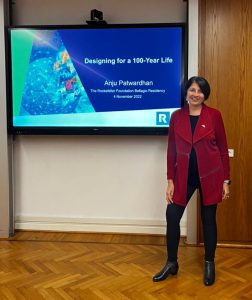
Anju at her Bellagio Residency presentation, November 2022